Before the World Started Counting
October 7 came after decades of Palestinian dispossession, 56 years of Israeli military occupation, 16 years of blockade in Gaza, accelerating settlement expansion, mass displacement and a system of domination that major Palestinian, Israeli and international human-rights organizations had already described as apartheid. Human Rights Watch concluded in 2021 that Israeli authorities were committing the crimes against humanity of apartheid and persecution, while the Israeli human-rights organization B’Tselem described the system that same year as one of Jewish supremacy from the Jordan River to the Mediterranean Sea.
What followed October 7 was not simply another chapter in an abstract “conflict.” Israel’s assault on Gaza produced destruction on a scale that Amnesty International, following an investigation of Israel’s conduct and statements by Israeli officials, concluded constituted genocide. Its report examined killings, serious bodily and mental harm, mass displacement, the destruction of civilian infrastructure, restrictions on power and the obstruction or denial of life-saving goods and humanitarian aid.
The history of Palestine cannot be made to begin at the moment Israelis suffered violence.
For Palestinians, coercion and violence were already embedded in the structure of daily life long before that morning: military occupation, land confiscation, settlement construction, home demolitions, displacement, military raids, restrictions on movement and, in Gaza, a blockade that governed whether people could leave, what goods could enter, how far fishermen could sail and whether patients could reach hospitals outside the territory.
Even the immediate days before October 7 were not peaceful.
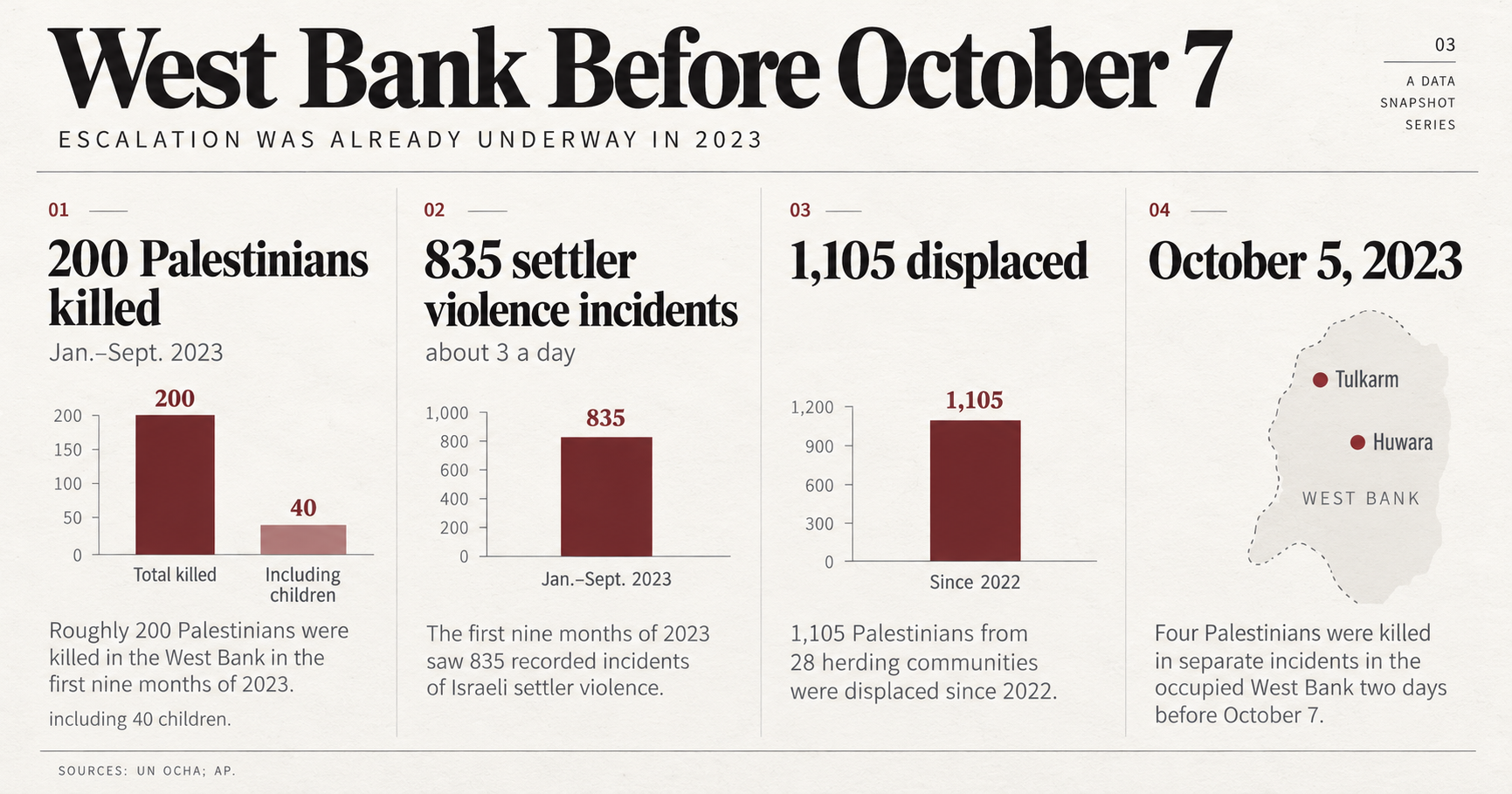
On October 5, 2023, four Palestinians were killed in the occupied West Bank in separate incidents. During an Israeli raid on the Tulkarm refugee camp, Palestinian gunmen exchanged fire with Israeli forces and five Israeli Border Police officers were wounded. Israeli forces later killed two Palestinians, Abdulrahman Atta, 23, and Hudhaifa Fares, 27, near Tulkarm. In Huwara, Israeli forces killed another Palestinian after he opened fire at an Israeli vehicle; no one inside the vehicle was injured. Later, after Israeli settlers entered the town and clashes erupted with Palestinian residents, 19-year-old Labib Dhamidi was killed. The Associated Press reported the four Palestinian deaths and the broader escalation on October 5.
Those deaths were not an isolated eruption days before October 7. They were part of a year in which violence across the occupied West Bank had already reached extraordinary levels.
By the end of 2023, the United Nations would record 507 Palestinians killed in the West Bank, including East Jerusalem, the highest annual figure since the UN began systematically recording casualties there in 2005. But a substantial share of that violence had already occurred before October 7. Based on later UN totals, roughly 200 Palestinians had already been killed in the West Bank during the first nine months of 2023, including 40 Palestinian children. OCHA later reported that 40 Palestinian children were killed in the West Bank in the first nine months of 2023 alone.
Settler violence was surging at the same time. Before October 7, OCHA was recording an average of approximately three settler-related incidents affecting Palestinians every day, the highest rate the agency had recorded since it began systematically monitoring such incidents in 2006. These were attacks resulting in injury, death or damage to Palestinian property. For communities already facing demolition orders, military restrictions and settlement expansion, violence was not an exceptional event. It was part of the environment in which daily life took place.
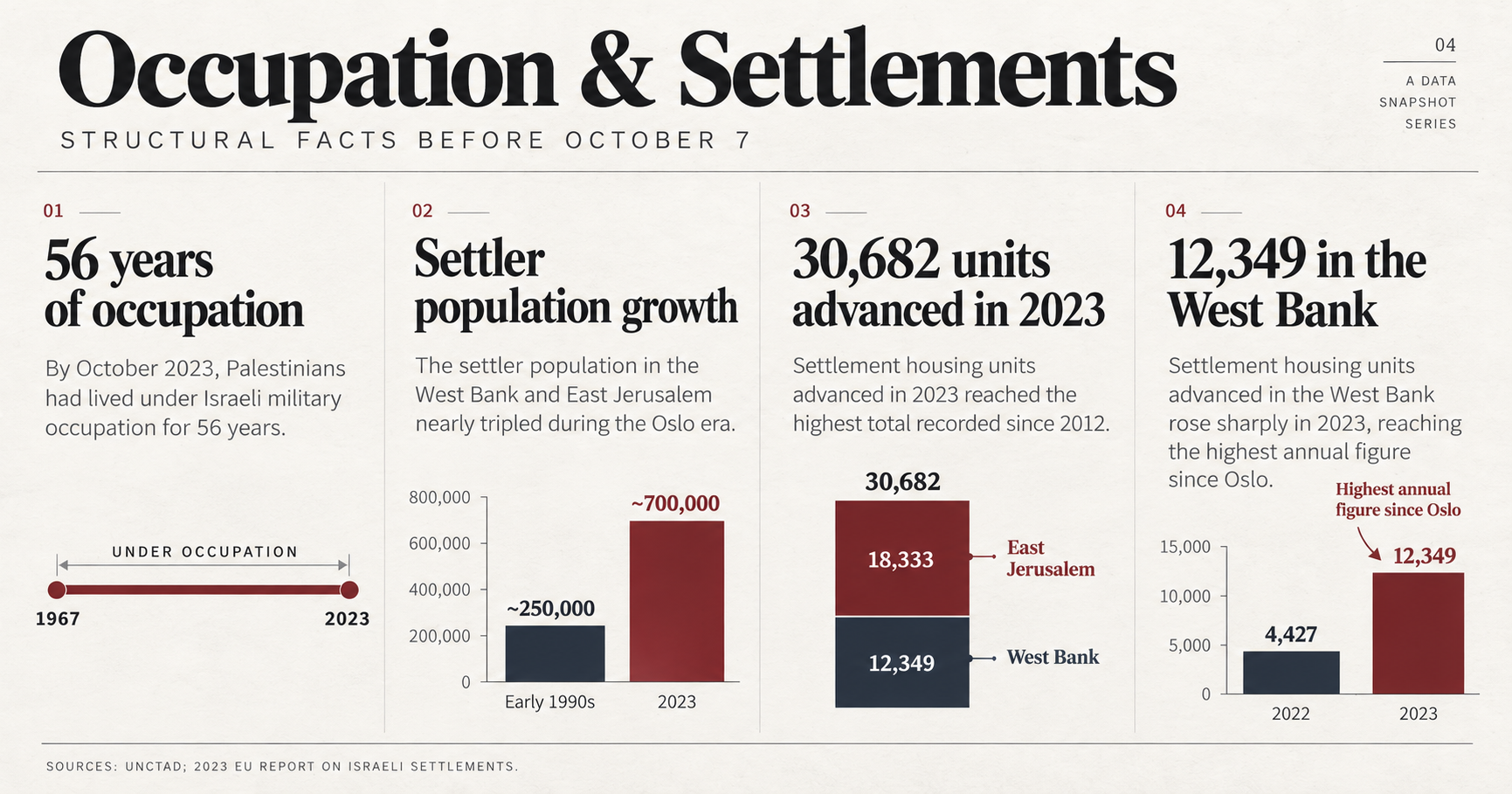
The West Bank was also being physically transformed around its Palestinian population. By 2023, roughly 700,000 Israeli settlers were living in the occupied West Bank, including East Jerusalem. Settlement growth continued despite the international consensus that Israeli settlements in occupied territory violate international law. The population of settlers had expanded dramatically during the same three decades in which Palestinians were repeatedly told that negotiations would eventually produce an independent state.
That contradiction was increasingly difficult to ignore. Palestinians had been asked to place their future in a political process while the territory on which that future state was supposed to exist was steadily fragmented by settlements, settler-only or restricted road networks, military zones, checkpoints and the separation barrier.
Gaza represented an even more extreme form of confinement.
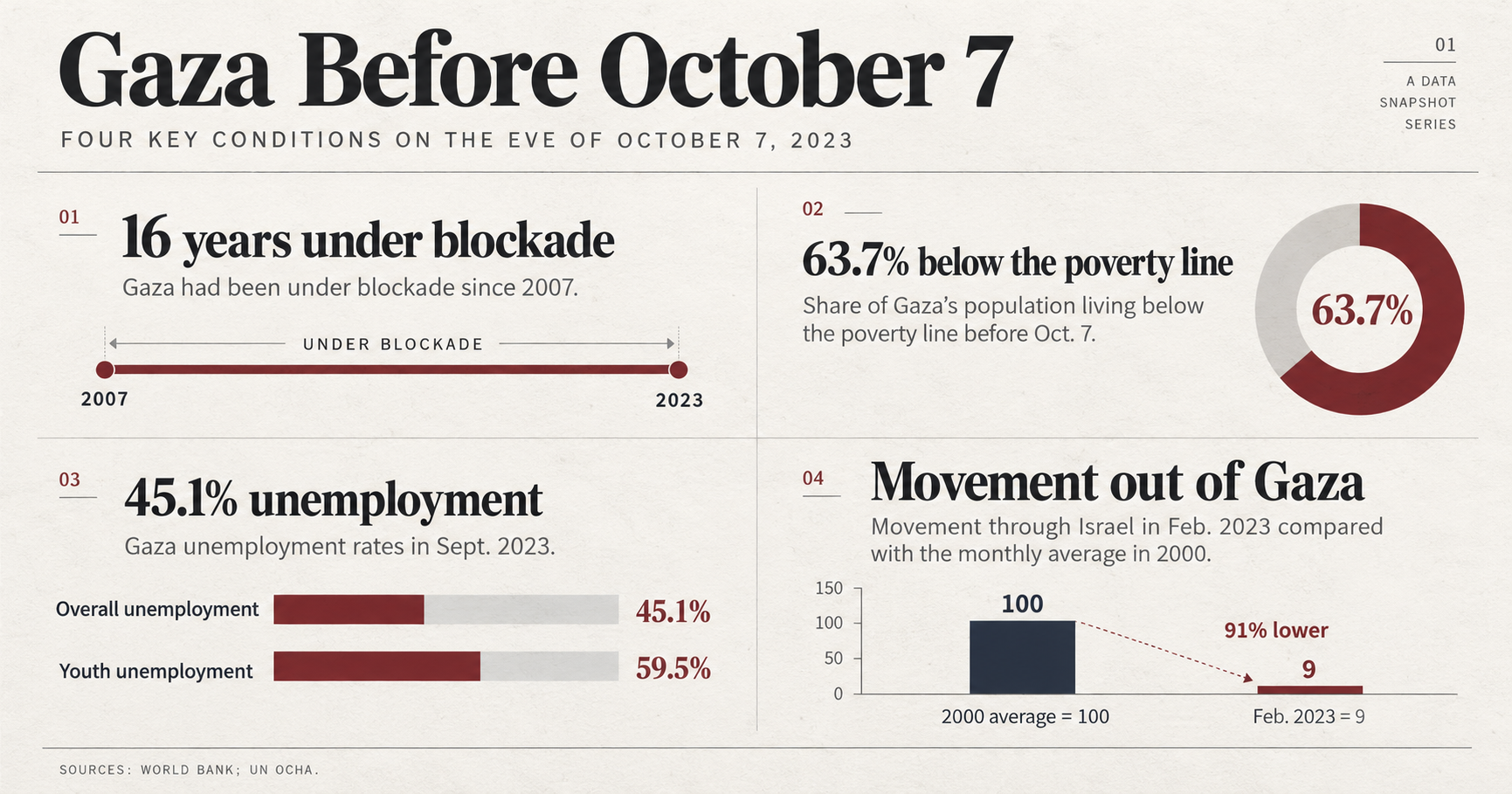
By October 2023, more than two million Palestinians had lived under blockade for 16 years. Israel imposed sweeping restrictions on the movement of people and goods after Hamas took control of Gaza in 2007, while Egypt also restricted movement through the Rafah crossing. Gaza had no functioning airport. Ordinary residents could not simply board a plane, drive into another Palestinian city or leave through an Israeli crossing. Exit depended on limited eligibility categories and permits.
The scale of that restriction is visible in the movement data. Even after Israel expanded certain categories of permits in the years immediately preceding October 7, exits from Gaza remained dramatically below levels recorded before the tightening of restrictions. Most Palestinians in Gaza were not eligible to apply for an Israeli exit permit at all. Medical patients, humanitarian workers, traders and laborers were among the categories that could potentially receive permission. Freedom of movement itself was not the default.
The blockade did not merely restrict travel. It helped shape nearly every major economic indicator in Gaza.
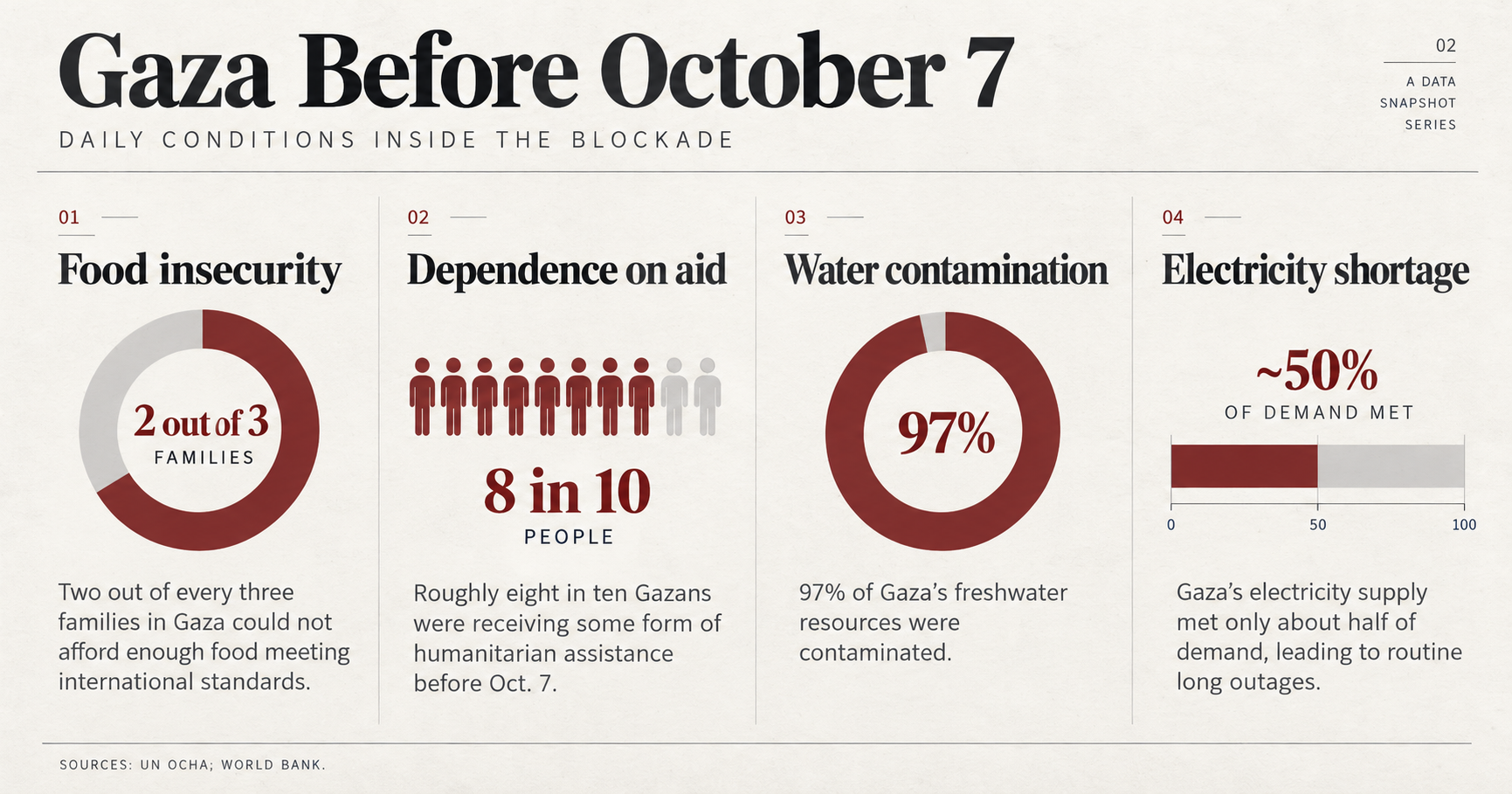
Before October 7, 63.7 percent of Gaza’s population was already living below the poverty line, according to World Bank analysis of 2023 household data. Six out of every ten people in Gaza were living in poverty before Israel’s post-October 7 assault began. Of all Palestinians living in poverty across Gaza and the West Bank, nearly 79 percent lived in Gaza.
Unemployment was endemic. In the period immediately before October 7, roughly 45 percent of Gaza’s labor force was unemployed, with the rate among young people substantially higher. A generation of Palestinians could complete school or university and enter adulthood with little realistic prospect of stable employment, not because Gaza lacked an educated population or entrepreneurial capacity, but because its economy operated under severe restrictions on trade, movement, imports, exports and access to external markets.
Humanitarian aid had consequently become woven into Gaza’s survival long before the world began seeing aid trucks on television after October 7. Large portions of the population depended on food assistance and other humanitarian support. This was not a temporary emergency produced by a natural disaster. It was a chronic condition in a territory subjected to years of closure, recurrent bombardment and economic isolation.
Water offered perhaps the clearest example of what those conditions meant in ordinary life. Gaza’s coastal aquifer, its primary natural freshwater source, had for years been damaged by over-extraction, saltwater intrusion and contamination. Much of the water drawn from it was unsafe to drink. Families who could afford to do so bought desalinated or trucked water because tap water could not reliably meet drinking-water standards.
Electricity was similarly unreliable. Gaza’s power supply had long fallen short of demand, producing scheduled daily outages that affected refrigeration, hospitals, water pumping, sewage treatment, businesses and households. These shortages existed years before the destruction of Gaza’s electrical infrastructure after October 7.
A person living in Gaza did not experience “the blockade” as an academic foreign-policy concept. It determined whether a cancer patient received permission to leave for treatment. Whether a student could study abroad. Whether a fisherman could sail far enough to earn a living. Whether a manufacturer could obtain machinery or raw materials. Whether a family could count on electricity overnight. Whether water from the tap was safe for a child to drink.
By October 2023, an entire generation had been born and raised inside that system. A Palestinian born when the blockade began in 2007 was 16 years old on October 7, 2023. They had never known Gaza without it.
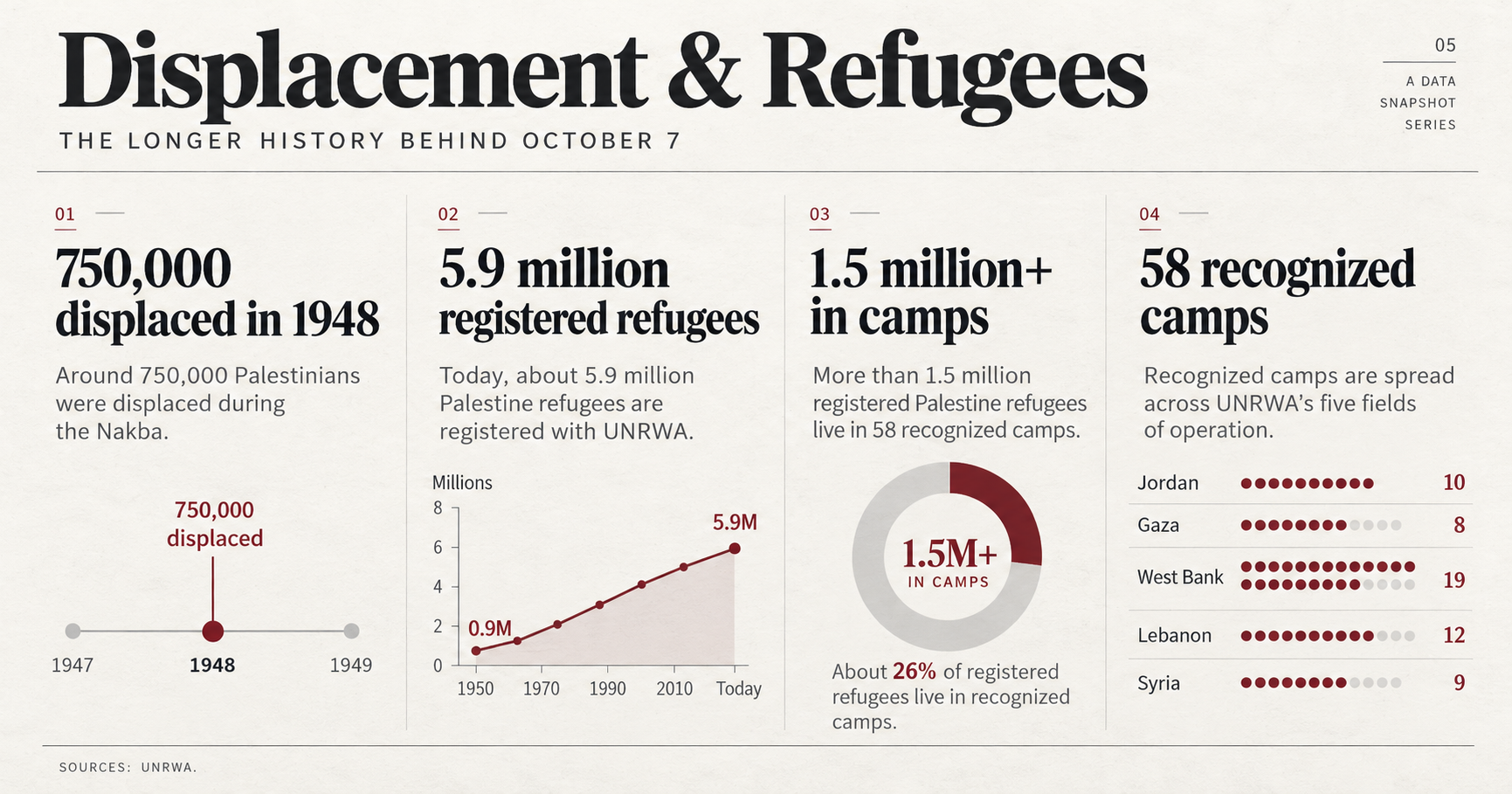
The population itself also carried the legacy of an earlier displacement. A majority of Palestinians in Gaza were refugees or descendants of refugees displaced from towns and villages during the Nakba. Approximately 750,000 Palestinians became refugees during the mass displacement surrounding Israel’s establishment in 1948, and millions of Palestinians and their descendants remain registered as refugees today.
In Gaza, this history has an especially brutal geography. Many refugee families have ancestral towns and villages only a few miles from the strip. The distance is small enough to measure in minutes. Politically, it has remained impassable for generations.
The year preceding October 7 had offered little reason to believe that any of these structures were approaching an end.
Israeli settlement expansion continued. Palestinian communities in the West Bank faced demolitions and displacement. Settler attacks were reaching record levels. Israeli military raids into Jenin, Nablus, Tulkarm and other Palestinian communities had become increasingly frequent and lethal. Gaza remained blockaded. There was no meaningful peace process, no credible timetable for Palestinian statehood and no indication that the occupation, then in its 56th year, was becoming temporary.
The promise underlying the Oslo process had been that negotiations would eventually replace occupation with Palestinian self-determination. Thirty years later, Palestinians entered October 2023 with less territorial continuity, a dramatically larger settler population and a political process that had effectively collapsed.
This was the reality on October 6.
It does not make attacks against Israeli civilians lawful. Civilians do not lose their protection because of the government under which they live, and the crimes committed against civilians on October 7 should not be erased or minimized.
But context and justification are not the same thing. Refusing to erase the conditions that preceded October 7 is not an attempt to legalize what happened that day. It is a refusal to accept a version of history in which decades of violence against Palestinians are reduced to a footnote while Palestinian violence becomes the event from which all explanation must begin.
There is a profound asymmetry in the language routinely used to describe this history. Israeli violence is frequently absorbed into institutional language: security operations, closures, permit regimes, settlement policy, military necessity. Palestinian violence is treated as a rupture requiring immediate explanation. One is presented as the background. The other becomes the beginning of the story.
That distinction matters.
By October 7, Gaza was a territory where almost two-thirds of the population lived in poverty, nearly half the workforce was unemployed and most residents could not freely leave. Its people had endured 16 years of blockade and repeated Israeli military operations. In the West Bank, Palestinians had spent 56 years under occupation while the settler population expanded into the hundreds of thousands. Forty Palestinian children had already been killed there in the first nine months of 2023. Settler attacks were occurring at the highest rate the UN had recorded. A political settlement was nowhere in sight.
And two days before October 7, another four Palestinians were dead.
None of that appeared suddenly on October 8.
Nor did the system disappear once the world’s attention turned toward Israeli suffering. Instead, Israel launched an assault on Gaza whose human toll and destruction led Amnesty International to conclude in December 2024 that Israel had committed genocide against Palestinians in Gaza. The legal characterization remains contested: Israel rejects the accusation of genocide, and proceedings brought by South Africa under the Genocide Convention remain distinct from Amnesty’s organizational finding. But reducing what has happened in Gaza to an undefined “conflict” obscures the gravity of both the allegations and the documented scale of Palestinian destruction.
October 7 must therefore be remembered in full context, not isolated from everything that made October 6 possible.
For decades, Palestinians were asked to endure occupation while waiting for diplomacy to work, to endure settlement growth while waiting for a state, and to endure blockade while being told that their confinement was necessary for someone else’s security. Their political horizon narrowed as the physical space available to them narrowed with it.
The dominant question after October 7 was how such violence could have occurred.
That question cannot be answered seriously if the investigation begins on the morning it happened.
Before October 7 came October 6. Before October 6 came decades of occupation, dispossession, blockade, displacement and failed political promises. Those facts do not disappear because acknowledging them makes the history more difficult.
They are the history.