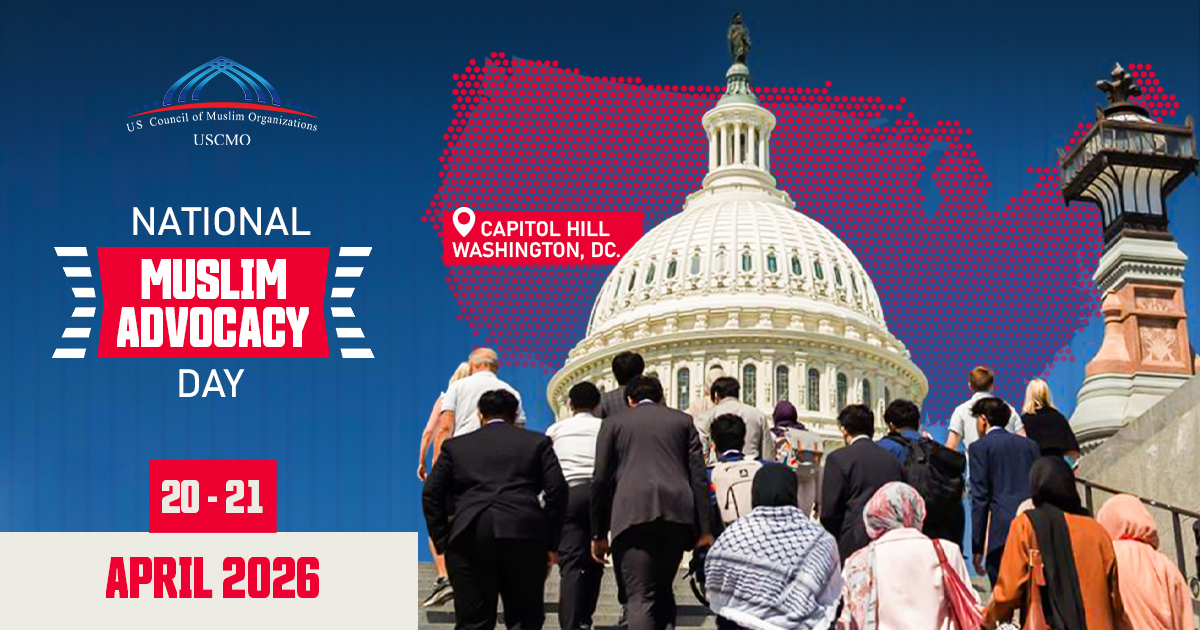
(Washington, D.C., 4/21/2026) – The US Council of Muslim Organizations (USCMO), the nation’s largest American Muslim civil society umbrella organization, today announced the successful completion of the 11th Annual National Muslim Advocacy Day on Capitol Hill, with more than 1,000 Muslim delegates – a record number – from 33 states traveling to Washington, D.C., for two days of coordinated advocacy.
USCMO said this year’s theme, “Dismantling Islamophobia, Demanding Accountability, and Fighting for Justice,” reflected the urgency created by the current social and political climate.
Over the course of the two days, Muslim delegations held more than 260 meetings with members of Congress and congressional staff, in addition to dozens of drop-by visits across Capitol Hill.
This year’s record number of Muslim delegates was made possible through the sustained organizing, outreach, and mobilization efforts of more than 70 organizations and masajid across the country. A special recognition goes to the Islamic Circle of North America (ICNA), the Council on American-Islamic Relations (CAIR), and the Muslim Ummah of North America (MUNA) for leading the initiative with the highest number of registrants receiving the 1st Place Award, 2nd Place Award, and 3rd Place Award, respectively.
Delegates met with their elected officials to advance a focused policy agenda, urging members of Congress to:
Oppose Anti-Muslim Caucuses and Legislation
Reject the so-called “Sharia-Free America Caucus” and its discriminatory bills (H.R. 5722 / S. 3009, H.R. 5512 / S. 3008, H.R. 7611), which manufacture fear and legitimize anti-Muslim bigotry under the guise of national security. Support a congressional letter opposing this unconstitutional targeting of Islamic religious practice.
Demand an End to Endless Wars and the “Israel First” Agenda
Congress must stop rubber-stamping foreign agendas while American families struggle at home. Cut off taxpayer funding enabling genocide in Gaza, oppose reckless escalation toward war with Iran, and address atrocities in Sudan. Support War Powers efforts and reclaim Congress’s constitutional authority over war.
Defend Free Speech and Immigration Rights
Free speech is not terrorism, and activism is not grounds for detention, deportation, or IRS retaliation. Congress must end the weaponization of immigration law and tax authority against activists and nonprofits and reject efforts to silence dissent through abuse of power.
In addition to congressional advocacy, Muslim Hill Day included high-profile public actions addressing civil rights and political repression.
On Monday, advocates held a press conference in front of the U.S. Supreme Court calling for the release of Milwaukee Muslim community leader Salah Sarsour, who remains in ICE detention over his Palestinian activism. Speakers highlighted a broader pattern of targeting activists for their political speech, referencing cases over the past year involving Palestinian and Muslim advocates facing detention, harassment, or immigration-related retaliation, including Mahmoud Khalil, Rasha Alawieh, and others subjected to similar scrutiny.
On Tuesday, USCMO held a joint press conference with Congressman Al Green in support of his resolution to condemn Andy Ogles for anti-Muslim hate speech. Speakers emphasized that Islamophobia in Congress must be confronted directly and cannot be normalized or ignored.
In a statement, USCMO Secretary General Oussama Jammal said:
“From a record number of American Muslims coming to Capitol Hill, we are demonstrating what sustained grassroots community power looks like when it is organized, disciplined, and translated into civic engagement. For more than a decade, Muslim communities across this country have been building local infrastructure, cultivating leadership, and turning that investment into a consistent, annual presence on Capitol Hill backed by year-round in-district advocacy. That is why we are able to show up with strength, hold more than 260 meetings, and demand accountability from those in power. We will not accept the normalization of anti-Muslim hate disguised as policy. The so-called ‘Sharia-Free America Caucus’ and its discriminatory legislation must be rejected for what they are, an assault on religious freedom and constitutional rights. Congress must also end its complicity in endless wars and foreign agendas that betray American values, including the ongoing genocide in Gaza. And let there be no confusion, free speech is not a crime, dissent is not terrorism, and our communities will continue to organize, mobilize, and hold every elected official accountable.”
In a statement, Robert S. McCaw, Chair of the USCMO National Muslim Advocacy Day Steering Committee and CAIR Director of Government Affairs, said:
“Muslim Hill Day reflects years of intentional grassroots organizing that has built real community power and translated it into sustained civic engagement. This is not a one-day event. It is the visible expression of ongoing work happening in communities across the country, where Muslim advocates are meeting with their elected officials year-round, building relationships, and advancing policy priorities at both the local and federal levels. The fact that Muslim delegates held more than 260 meetings over two days is a direct result of that infrastructure and follow-through. Our community is no longer asking to be included in policy conversations, we are shaping them. Lawmakers are engaging with a constituency that is organized, informed, and consistently present both in Washington and back home in their districts.”
USCMO also hosted a comprehensive policy and advocacy training session at the U.S. Capitol Visitor Center auditorium on Monday morning, equipping hundreds of participants with the tools and messaging needed for effective engagement with lawmakers.
Throughout the week, Muslim delegates operated out of the Rayburn House Office Building, creating a centralized hub for coordination, communication, and rapid response. This structure helped maximize the impact of the record turnout and ensured that the 11th Annual National Muslim Advocacy Day delivered both a visible show of presence and measurable policy engagement.
###